

What exactly is a Bunion?
The origin of the word comes from the early 18th Century, derived from the old French word buigne meaning “bump on the head ”.
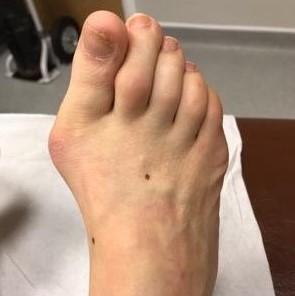
A more modern meaning is ‘a painful swelling on the first joint of the big toe; (metatarsophalangeal joint).
The correct medical term for a bunion is Hallux valgus which describes the movement of the Hallux or ‘big toe’ towards the second toe leading to a dislocation of this joint and giving rise to a bunion.
The same dislocation can also occur over the joint of the fifth toe forming a bunionette.

Bunion Bunioneette

What Causes a Bunion? Are they Hereditary?
The answer is we don’t really know. Over the years there have been many research projects and schools of thought as to the exact causation of Bunions.
This image shows the left foot of a mum of 32 years and the left foot of her 5 year old daughter. What is clear is that both mum and daughter both have a left bunion deformity. If you look more closely you can see that both big toes lay underneath the second toe, the second toe lays over the third toe, the fourth toe lays underneath the third toe, and the fifth toe lays underneath the fourth toe. Both feet are broad at the front and all the lesser toes are retracted.

It is our opinion that the daughter has inherited her mothers’ foot type, meaning that certain foot types or shapes can predispose to certain mechanical dysfunctions e.g toe deformities and bunions.
It is widely documented that tight, narrow and high heeled shoes can cause bunions. I’m quite sure that this little 5 year old has not yet taken to wearing 6 inch stiletto heels, therefore one would assume that footwear will aggravate a pre-existing bunion deformity and may well contribute to the formation of one.
Footwear is therefore an aggravating factor to the predisposition of a bunion deformity not a cause.
What is clear from researchers is that certain foot types eg high arch feet, flat feet, hypermobile feet can all form bunions; therefore we can interpret that a bunion is a symptom caused by numerous complexities in foot types each having their own dysfunctional properties which can lead to the causation of a bunion.
Other contributory factors may include:
Footwear rubbing over a prominent bunion Bunion associated with Rheumatoid Arthritis


At The Yorkshire Foot Hospital in Leeds, we tend to see a ratio of 3:1 women to men
What type of symptoms will you have with your bunions ?
Painful callus over bunion caused by rubbing from footwear After surgery Before bunionette surgery After bunionette surgery


How we carefully select our Patients
Prior to considering surgical treatment for Bunion correction, we advise all our patients that once you have fully exhausted all non-surgical treatments and you still present with the following:
If you satisfy these criteria we will be happy to offer you treatment at The Yorkshire Foot Hospital, Leeds.

Most successful Bunion Surgery procedure at The Yorkshire Foot Hospital, Leeds
Scarf Akin Osteotomy
Please click on the video to watch.

“I love to wear elegant and open toe shoes but I always felt that people were looking at my feet. I was recommended by a work colleague to see Mr Steve Finney a Consultant Podiatric Foot Surgeon at The Yorkshire Foot Hospital in Leeds. Within 6 weeks I was back at work. Being able to spread the cost of my operation with a loan was brilliant ! They even offered me a 0% finance payment plan.”
Leah Richards 23
Secretary, Leeds
Frequently Asked Questions
What is a bunion?
A bunion is a change in alignment around the joint at the base of the big toe. The big toe may angle towards the smaller toes while a prominence develops on the side of the joint.
What causes bunions?
Bunions are associated with foot structure and can run in families. Footwear may aggravate pressure and discomfort, but tight shoes are not considered the only cause.
Do all bunions need surgery?
No. If a bunion is not painful or limiting activity, treatment may not be needed. Wider, comfortable footwear, padding and other non-surgical measures may help manage symptoms.
When should I consider bunion surgery?
Surgery may be considered when pain, deformity or difficulty with footwear continues to affect daily life despite appropriate non-surgical care. The decision should follow an individual assessment.
How long does it take to recover from bunion surgery?
Recovery depends on the operation, the extent of correction and individual healing. The hospital’s page describes some patients returning to trainers at around two weeks and work or sport at around six weeks, but this is not guaranteed and your surgeon will give you specific advice.